
Vietnam's Draft Data Security Law: What Companies Need to Know Before 2027
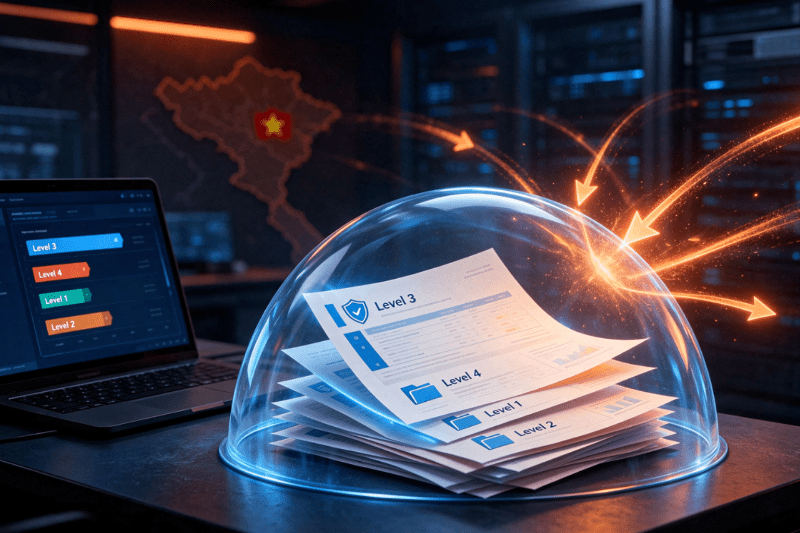 Vietnam is preparing a major overhaul of its data protection framework. The Ministry of Public Security has drafted a new Law on Data Security that would change the way companies classify, protect and move data across borders. The draft is currently under review by the National Assembly and is expected to enter into force on 1 December 2027.
So, what does it actually mean for businesses?
The Law on Data Security puts special emphasis on three core points:
1. Data classification – Under the draft, companies would have to identify and classify the data they manage into four categories: Ordinary Data (Level 1), Internal Data (Level 2), Important Data (Level 3) and Core Data (Level 4). In other words, the higher the category, the more stringent the requirements.
The risk level itself would be determined by several factors: the likelihood of unauthorised access, exploitation or use of the data, or of cyberattacks against it; the scale and scope of impact if data is disclosed, lost, modified or destroyed unlawfully; and other relevant considerations. On top of that, according to the new draft, data must be protected throughout its entire life cycle — from creation and retention to deletion.
2. Cross-border data flows – Any transfer of Important Data or Core Data outside Vietnam would be governed by stricter requirements. This matters a great deal for multinational groups that operate on overseas servers, depend on foreign cloud providers, share regional databases or process data across borders.
3. Penalties – A company that fails to protect Important Data or Core Data could face penalties of up to 5% of its total revenue for the previous financial year. For multinationals, the rules get tougher: if their revenue in Vietnam is below 5% of their consolidated global revenue, or if the impact from a violation extends beyond Vietnam, the fine can reach up to 5% of the corporation's global revenue. In practice, a breach involving the most sensitive data categories can cost far more than any information security budget.
How SearchInform Next-Gen DLP can help
SearchInform meets the requirement to protect data throughout its entire life cycle through a combination of the FileAuditor DCAP module (for data at rest) and the Next-Gen DLP system (for data in motion).
The SearchInform FileAuditor DCAP module comes with ready-made rules that automatically tag files according to their confidentiality level. It also allows access rights to be configured for users according to their job duties and the type of data they handle.
SearchInform Next-Gen DLP prevents data transfers that violate the organization's security policies, provides built-in investigation tools, and delivers automated reporting with an evidence trail, making regulator engagement easier.
The key advantage for the Vietnamese context is the option of a fully on-premises deployment: the entire monitoring environment, including the event archive and forensic data, stays on the company's own servers, creating no additional channel for cross-border data transfers.
ABOUT SEARCHINFORM
SearchInform is an information security and risk management product vendor as well as an MSS provider. The company's clients are more than 4000 companies in 20+ countries. Today, the team has products and services for comprehensive protection against insider threats at all levels of corporate information systems: FileAuditor (the DCAP class solution); DLP system with extended functionality; Risk Monitor (advanced platform for internal threat mitigation); SIEM system, Information Security outsourcing service.

